Institution: University of Pennsylvania
Additional authors:Ying Sun MD, Jennifer Morrissette PhD, Adam Bagg MD
Session: AML secondary to myeloproliferative neoplasms and other types of disease progression in MPN
HISTORY
An 82-year-old female was diagnosed with chronic myelogenous leukemia (CML) in February 2007. Unfortunately, clinical details between then and 2012, when we initially encountered the patient, are not well documented. Reportedly, imatinib was begun in 2007 with a “good” molecular response, but required intermittent dosing (300 mg 4 days/week) due to thrombocytopenia. Upon “disease progression” (specifics not available, but reportedly an increase in BCR/ABL1 quantitative RT-PCR) in October 2010, imatinib was increased to 300 mg 5 days/week, and a year later, to a daily dose. In January 2012, the patient was switched from imatinib to dasatinib (100 mg daily) due to intolerable side effects, but dasatinib was soon held because of worsening cytopenias. A bone marrow study in April 2012 showed no evidence of disease progression and dasatinib was restarted in May 2012 at a reduced dose of 70 mg daily and then reduced further in August 2012 to 50 mg daily due to cytopenias; however, her platelet count continued to decrease and blasts were noted in the peripheral blood. A bone marrow biopsy and additional studies were performed in October 2012.
DETAILS
Bone marrow core biopsy: 1.7 cm x 0.2 cm, fixed in B5.
Variably cellular marrow (5-50% with 25% cellularity overall) with an expansion of scattered and clustered large blasts (approximately 40%). Maturing myeloid and erythroid elements were decreased, and megakaryocytes were decreased with some cytologic atypia (occasional small forms). Aspirate smear:The aspirate smear showed numerous large blasts (32%) with irregular nuclear contours, fine chromatin, prominent nucleoli, and moderate amounts of pale basophilic cytoplasm with some vague cytoplasmic vacuolization. Neither granules nor Auer rods were seen. Erythroid and myeloid elements showed maturation without cytologic atypia, and megakaryocytes were present with some cytologic atypia (small hypolobated forms).IMMUNOHISTOCHEMISTRY AND FLOW CYTOMETRY
Bone marrow flow cytometry:
Expanded population of blasts (49%) with the following dominant immunophenotype: CD33+ CD34+ HLA-DR+ with dim, variable or subset expression of CD11b, CD13, CD117, cCD3, and MPO.CYTOGENETIC FINDINGS
Bone marrow: 45,XX,del(6)(q21q25),-7[19]/46,XX,t(9;22)(q34;q11.2)[1].
MOLECULAR FINDINGS
BCR/ABL1 quantitative RT-PCR performed on the peripheral blood showed a 2.5 log decrease from the laboratory's diagnostic median. The previous study from April 2012 (when the bone marrow showed no evidence of disease progression and also when the patient was off all targeted therapy), showed a 1.2 log decrease from the laboratory's diagnostic median.
INTERESTING FEATURES
The main interesting feature of this case is the development of a t(9;22)-negative AML in the setting of a detectable t(9;22), suggesting that the patient does not have bona fide CML in blast phase (which would have been the most likely consideration), but rather, has two distinct leukemic clones. While the cytogenetic data suggest that the AML (dominant clone) appears not to have arisen from the (minor) CML clone, a common origin from a t(9;22)-negative ancestral clone cannot be excluded. Although there have been a number of reports in the literature of patients being treated with imatinib for their CML who develop a t(9:22)-negative AML (including those with monosomy 7, as evident here), these have been in the absence of a detectable t(9;22), which is not the case here.
PROPOSED DIAGNOSIS
Apparently clonally distinct t(9;22)-negative AML in a patient with residual t(9;22)-positive CML.
CONSENSUS GROUP: ADDITIONAL INFORMATION/STUDIES
Additional immunostains performed by consensus group:
NPM1: Nuclear-restricted nucleophosmin
CONSENSUS DIAGNOSIS
Acute myeloid leukemia, t(9;22)(q34;q11.2); BCR-ABL1 negative, in patient with persistent chronic myelogenous leukemia, BCR-ABL1 positive
| Bone marrow aspirate - 100x | 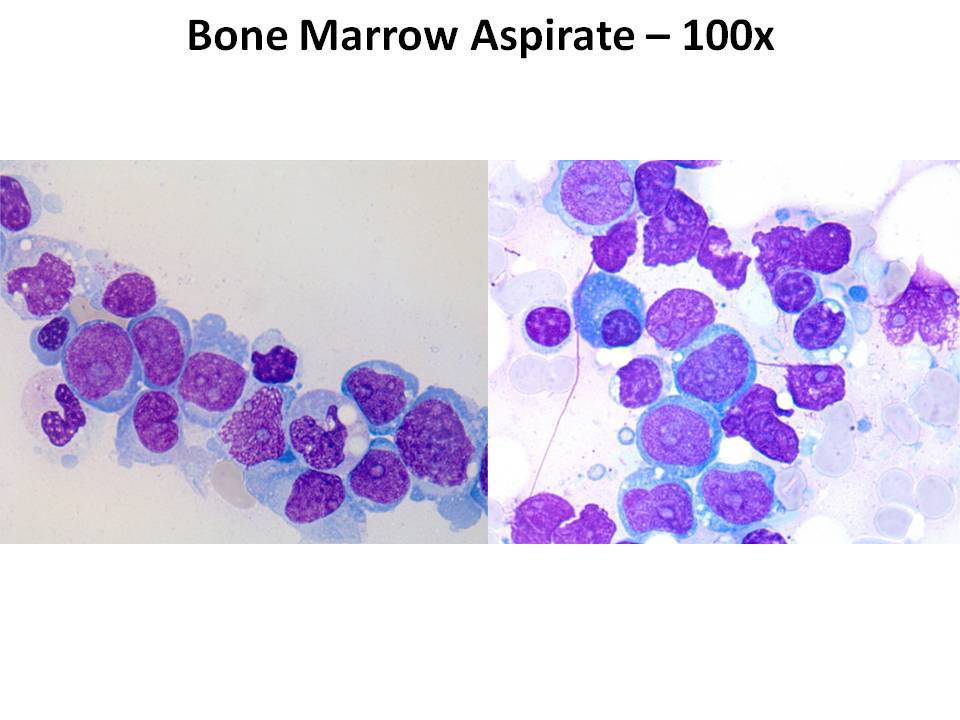 |
| Bone marrow biopsy - 40x | 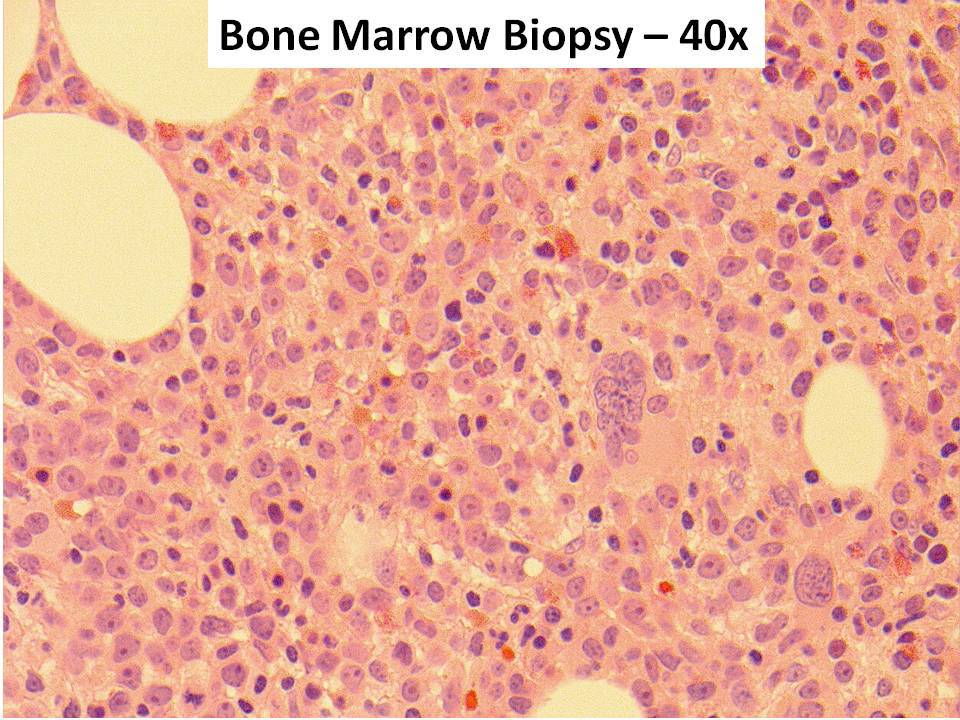 |
| Flow cytometry |  |
| Cytogenetics - Part 1 |  |
| Cytogenetics - Part 2 |  |