Institution: University of Utah and ARUP Laboratories
Session: AML with recurrent genetic abnormalities Part I
HISTORY
Thirty year old male, without a significant past medical history, presented with three weeks of profound fatigue and shortness of breath on exertion. On admission, a CBC demonstrated anemia (Hgb 9.0 g/dL) and thrombocytopenia (platelet count 25,000/uL) and a white blood cell count of 8200/uL.
DETAILS
A peripheral blood smear demonstrated approximately 71% mature segmented neutrophils with rare myelocytes and promyelocytes and approximately 9% blasts with no increase in basophils (1%). A bone marrow aspirate and biopsy were obtained from the left posterior iliac crest. The biopsy was decalcified and fixed in formalin. The aspirate smear demonstrated a markedly elevated myeloid to erythroid ratio of 11.5 and approximately 42% myeloblasts. Occasional maturing eythroid precursors demonstrated dyserythropoiesis. Dysgranulopoiesis was also noted. The biopsy demonstrated hypercellular bone marrow (approximately 95%) with sheets of immature cells.
CBC:
WBC: 1.3 x 1000/uL
Hemoglobin: 8.9 g/dL
Hematocrt: 25.5 %
Platelet: 19000/uL
IMMUNOHISTOCHEMISTRY AND FLOW CYTOMETRY
Flow cytometric immunophenotyping performed on an aspirate sample demonstrated that the myeloblast population expressed dim-CD45, CD13, CD15, CD33, CD117, HLA-DR and myeloperoxidase. Approximately 15% also expressed CD34.
CYTOGENETIC FINDINGS
46, XY, t(6;9)(p23;q34)[14] / 48, sl,+8,+13 [6]
MOLECULAR FINDINGS
An aspirate sample submitted for molecular testing demonstrated a FLT3 internal tandem duplication (ITD) mutation. The ITD was 63 base pairs in size and the FLT3 ITD allelic ratio (ratio of mutant to wild type) was 0.6. There was no evidence of an NPM1 exon 12 mutation or a CEBP-alpha mutation.
INTERESTING FEATURES
This young patient initially achieved a complete remission and underwent stem cell transplantation but relapsed (FLT3 ITD positive at relapse) soon thereafter. He then achieved a second remission with therapy that included a FLT3 inhibitor but ultimately died of sepsis. This case highlights the fact that the majority of cases of AML with t(6;9), approximately 70%, have FLT3-ITD mutations and brings up several additional questions: (1) Are FLT3-ITD mutations ultimately responsible for the poor prognosis of patients with t(6;9)? (2) The significance of FLT3-ITD mutations is well known in cytogenetically normal AML but what is the role for testing for FLT3 mutations in cases of AML with recurrent cytogenetic abnormalities like t(6;9)?
PROPOSED DIAGNOSIS
Acute myeloid leukemia with t(6;9)(p23;q34); DEK-NUP214 and a FLT3-ITD mutation.
CONSENSUS DIAGNOSIS
Acute myeloid leukemia with t(6;9)(p23;q34); DEK-NUP214, and FLT3-ITD mutation
| Bone marrow aspirate smear | .jpg) |
| FLT mutation testing | 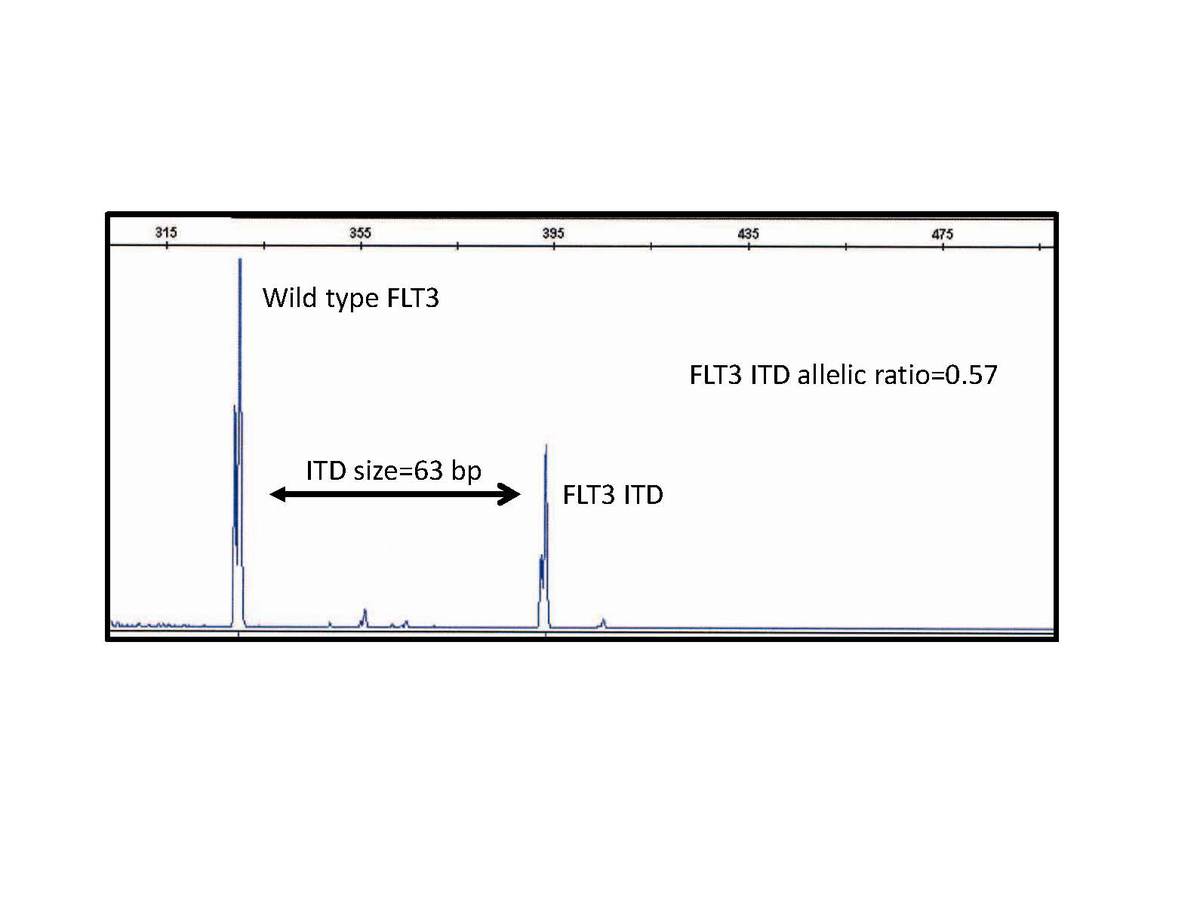 |