Institution: Wake Forest Baptist Health
Additional authors:Cyrus Manavi, MD, David Grier, MD
Session: Acute leukemias of ambiguous lineage
HISTORY
The patient is a 63-day-old male who initially presented with a one-week history of an enlarging left-sided neck mass. CT scan showed a large left-sided neck mass with multiple enlarged left cervical lymph nodes. An excisional biopsy of the neck mass and a bone marrow biopsy revealed myeloid sarcoma and acute monocytic leukemia respectively. Cytogenetics showed t(9;11)(p22;q23). The patient had remission after chemotherapy with doxorubicin, cytarabine and etoposide. Seventeen months after the initial diagnosis, he presented with a peripheral blast count as 26%. A bone marrow biopsy was performed and the diagnosis of B lymphoblastic leukemia was rendered. Cytogenetics showed t(9;11)(p22;q23). The patient then underwent induction (vincristine, PEG-aspariginase and cytarabine) and consolidation chemotherapy (methotrexate and 6MP). Bone marrow transplant (UCBT) was performed after chemotherapy. He is currently 8 months post unrelated cord bone marrow transplant and doing well.
DETAILS
The bone marrow core biopsy was B+ fixed, paraffin embedded, and stained with hematoxylin-eosin. Bone marrow aspirate smears were stained with Wright-Giemsa.
1) Left neck mass excisional biopsy: Soft tissue is replaced by monomorphic blasts with monocytic features.2) Initial bone marrow biopsy: Bone marrow is largely replaced by sheets of monoblasts and monocytes.3) Relapse bone marrow biopsy: Bone marrow biopsy shows sheets of small lymphoid blasts.IMMUNOHISTOCHEMISTRY AND FLOW CYTOMETRY
Blast immunophenotype:
Initial: CD34-/cMPO-/CD117-/CD45+/HLA-DR+/CD4+/CD11b+/CD15+/CD36+/CD64+/CD3-/CD10-/CD19-Relapse: CD34-/cMPO-/CD117-/CD45+/HLA-DR+/CD4-/CD11b-/CD15-/CD36-/CD64-/CD3-/CD10-/CD19+/cCD79a+/nTdT (+/-)/cCD22 (+/-)CYTOGENETIC FINDINGS
Both initial and relapse bone marrow showed t(9;11)(p22;q23).
MOLECULAR FINDINGS
Molecular cytogenetic analysis with DNA probe specific for detecting MLL gene rearrangements at 11q23 revealed that the gene was disrupted in both initial bone marrow (AML) and relapse bone marrow (ALL)
INTERESTING FEATURES
Acute leukemia with lineage switch at relapse is a relatively rare event, which occurs more often in children. MLL gene at 11q23 has been showed to be associated with the lineage switch. In previously reported cases of lineage switch, most patients initially presented with ALL and relapsed as AML. In the case reported here, the child originally presented with AML with t(9;11)(p22;q23) at age of 2 month old. 17 months after initial diagnosis, the patient developed a relapse with the lineage switch from AML to ALL. The leukemic cells at relapse possessed the same cytogenetic translocation of t(9;11)(p22;q23).
PROPOSED DIAGNOSIS
Acute leukemia with t(9;11)(p22;q23): presented with myeloid sarcoma and relapsed as acute lymphoblastic leukemia
CONSENSUS GROUP: ADDITIONAL INFORMATION/STUDIES
Additional immunostaining performed on sections from the original bone marrow biopsy and the 2010 left neck mass by the conference consensus group:
CD68: Strongly positive in blasts
Lysozyme: Strongly positive in blasts
CONSENSUS DIAGNOSIS
Acute leukemia with t(9;11)(p22;q23): presented with monocytic sarcoma and acute monocytic leukemiar, with relapse as B-acute lymphoblastic leukemia
| Fig 1 | 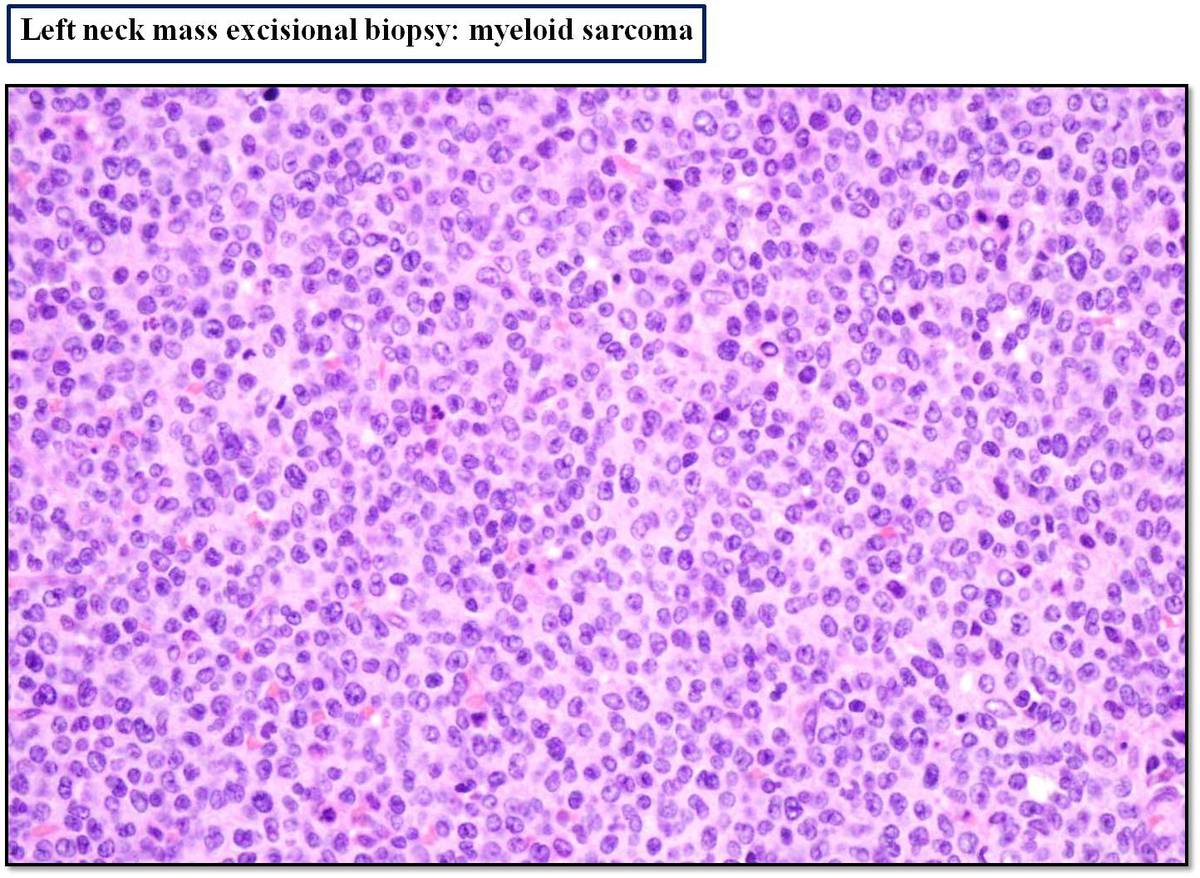 |
| Fig 2 | 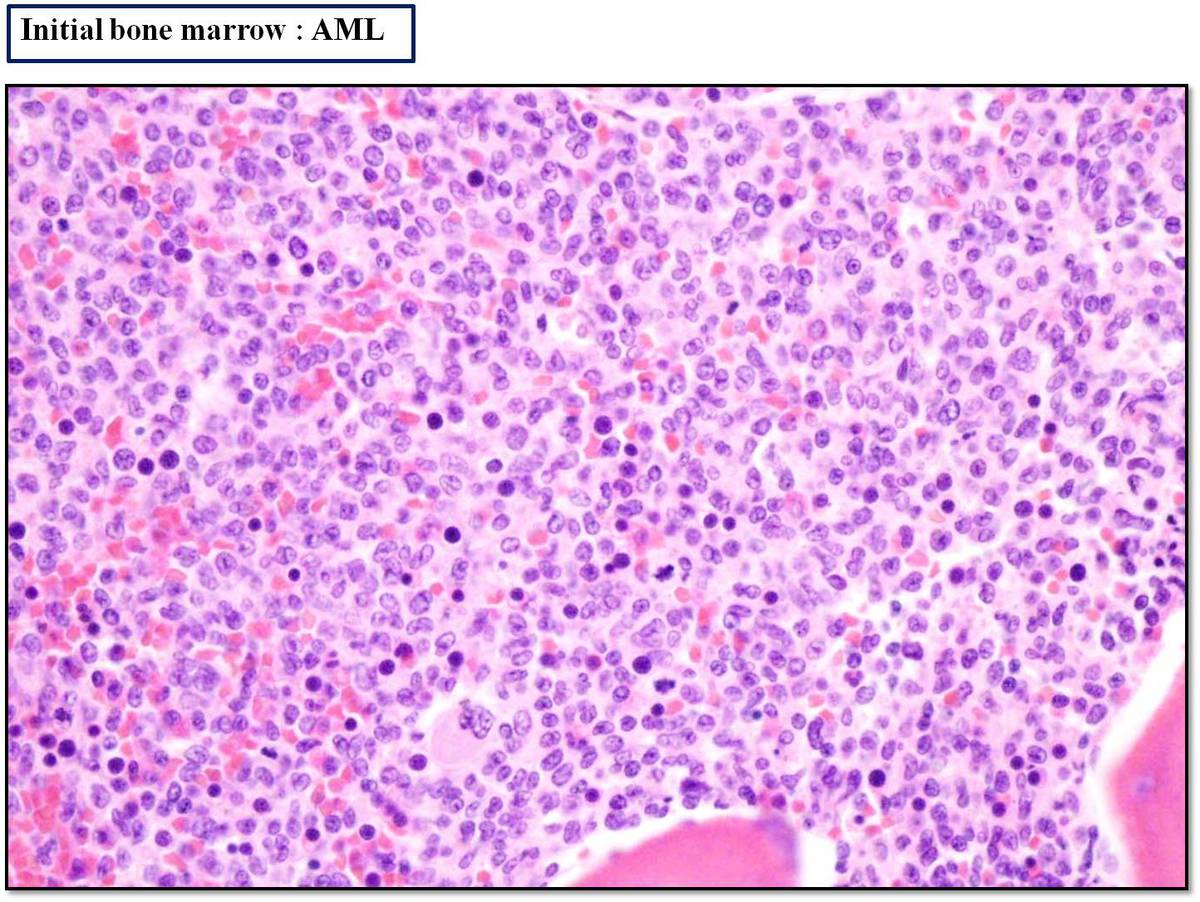 |
| Fig 3 |  |
| Fig 4 |  |
| Fig 5 |  |
| Fig 6 |  |
| Fig 7 |  |
| Fig 8 | 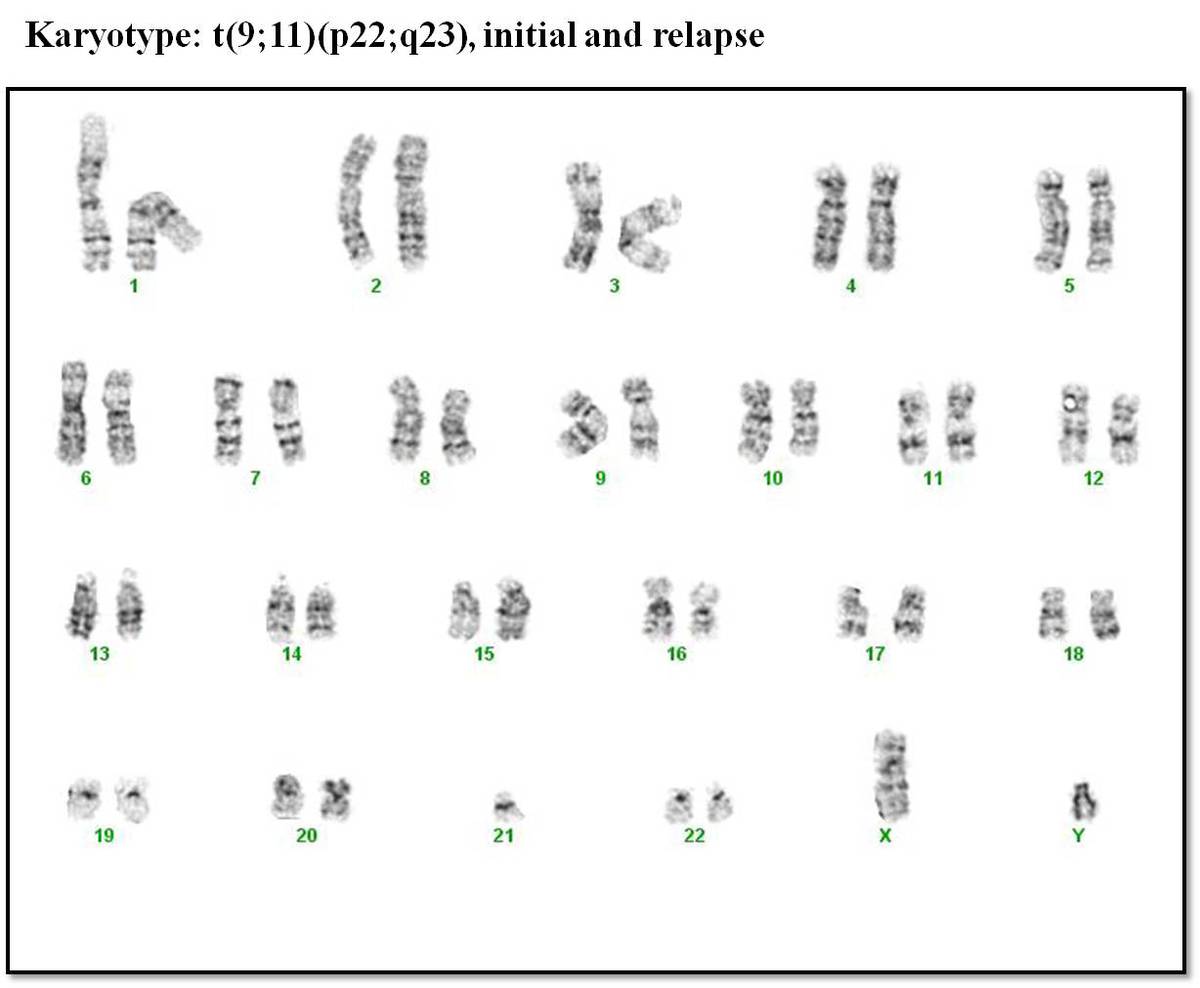 |
| Fig 9 |  |