Institution: University of Vermont / Fletcher Allen Health Care
Additional authors:Rhett P Ketterling, MD, Mayo Clinic
Session: B Lymphoblastic Leukemia/Lymphoma
HISTORY
A three-month-old girl was brought to her primary care provider due to decreased activity and progressive pallor. The child was the product of a normal pregnancy and delivery; she had been noted at one month of age to have a left-sided breast mass presumed to represent a hemangioma. About one month prior to presentation, she began to develop multiple subcutaneous nodules. A complete blood count revealed marked anemia (Hb 4.6 g/dl) and marked leukocytosis (WBC 426 K/µl).
DETAILS
Peripheral blood: Marked leukocytosis with a predominance of blasts (94%) intermediate in size with fine chromatin, inconspicuous nucleoli, and generally scant, variably vacuolated cytoplasm.
Bone marrow, subcutaneous lesions: No biopsy performed.IMMUNOHISTOCHEMISTRY AND FLOW CYTOMETRY
Flow cytometry: Blasts expressed CD19, CD34, CD38, and HLA-DR, and they were negative for CD10, CD20, surface light chains, T-cell markers, and myeloid markers.
CYTOGENETIC FINDINGS
46,XX[20].ish 11q23(MLLx2)[12]
nuc ish(5'MLL,3'MLL)x2(5'MLL sep 3'MLL)x1[50/200]nuc ish(MLLx2),(MLLT1x3),(MLL con MLLT1x1)[483/500]While conventional karyotyping revealed no anomalies, FISH with an MLL break-apart probe showed a very small split signal in 25% of interphase cells – an unexpected result given the very high blast percentage (94%). FISH with probes directed against common MLL translocation partners revealed an insertional translocation resulting in MLLT1/MLL fusion in 96.6% of nuclei. Given the normal karyotype, this represents a truly cryptic insertion of MLLT1 next to MLL on one of the chromosomes 11.MOLECULAR FINDINGS
None performed.
INTERESTING FEATURES
The clinical scenario, blood count results, and immunophenotypic data were prototypic for B lymphoblastic leukemia with MLL rearrangement. While conventional karyotyping was unrevealing, and FISH with an MLL break-apart probe yielded unusual findings, a cryptic insertional translocation resulting in MLLT1/MLL fusion was demonstrated by FISH. The patient is in remission nearly two years after presentation.
PROPOSED DIAGNOSIS
B lymphoblastic leukemia with 46,XX.ish ins(11;19)(q23;p13.3p13.3)(MLL+,MLLT1+;MLLT1+); MLL rearranged.
CONSENSUS DIAGNOSIS
B-acute lymphoblastic leukemia with 46,XX.ish ins(11;19)(q23;p13.3p13.3)(MLL+,MLLT1+;MLLT1+); MLL rearranged.
| Blasts in peripheral blood | 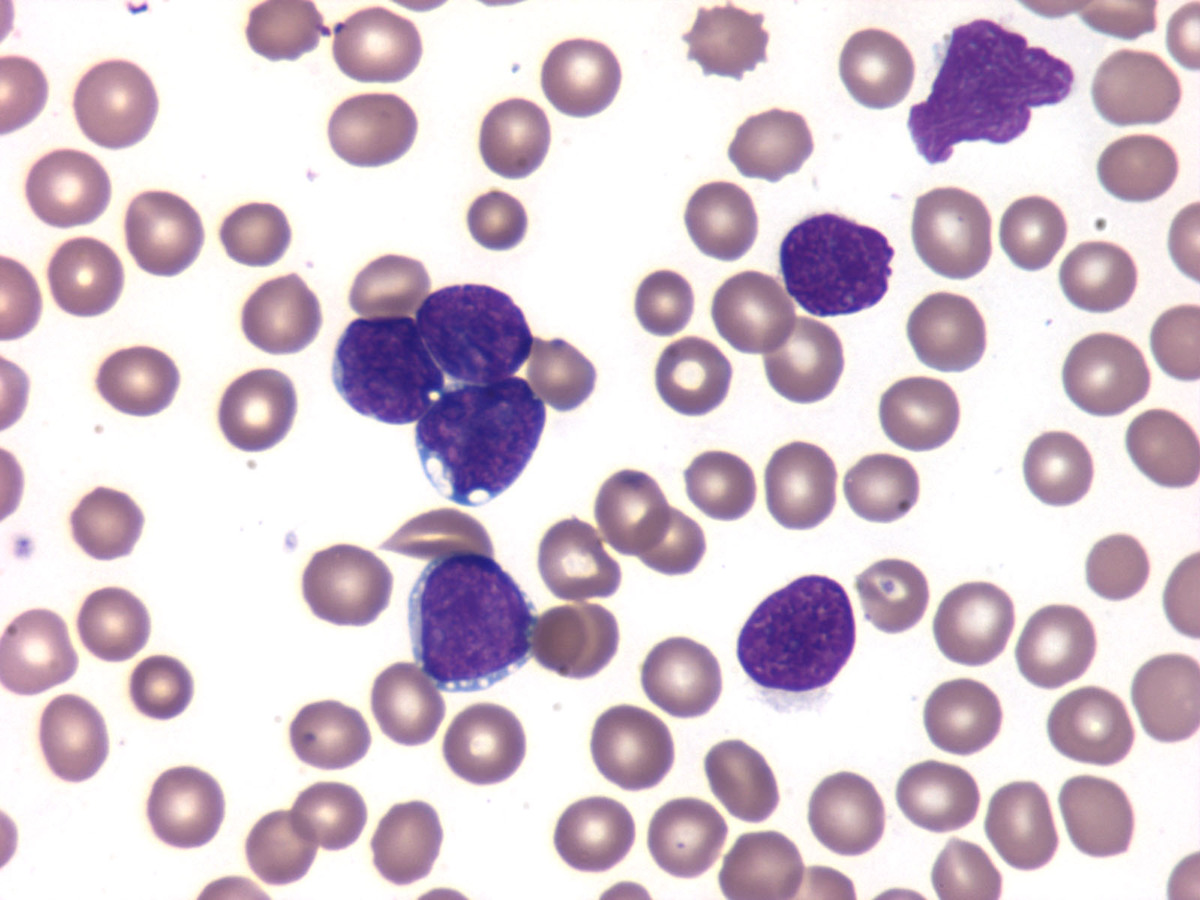 |
| FISH showing MLL/MLLT1 (ENL) insertional translocation | 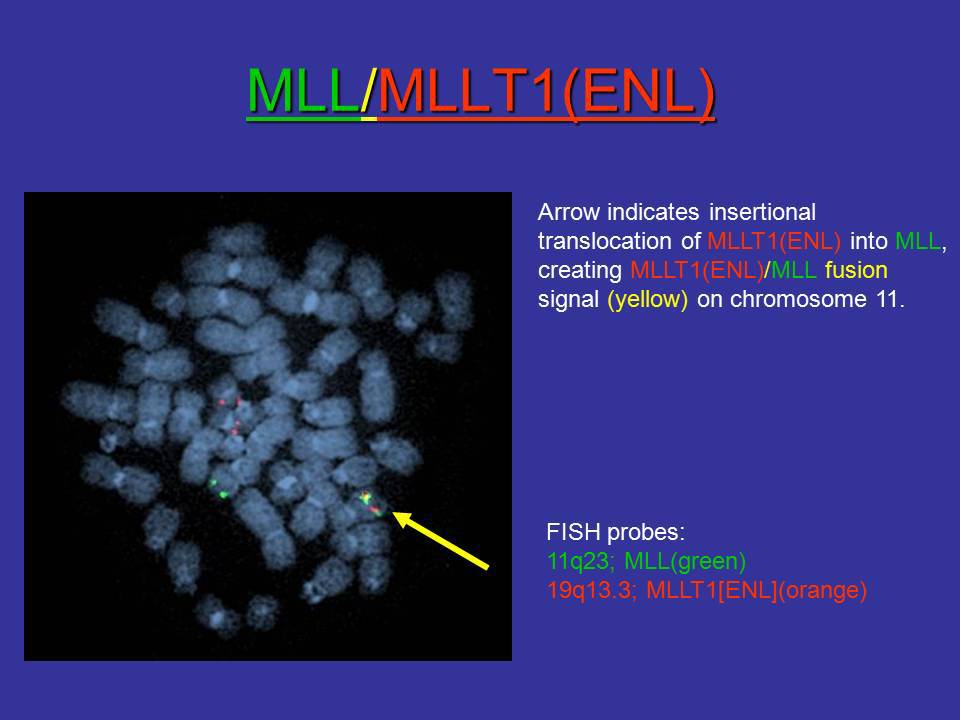 |