Institution: University of New Mexico Health Sciences Center
Additional authors:Cheryl L. Willman MD
Session: B Lymphoblastic Leukemia/Lymphoma
HISTORY
This 17 year old female presented with peripheral blood blasts, cytopenias, and mild hepatosplenomegaly. She was diagnosed with B lymphoblastic leukemia based on peripheral blood and bone marrow studies, and was CNS 2a with CNS WBC count <5/cu mm and 29% blasts present. Due to her age, she was started on the COG “high risk” protocol AALL0232. Because she was a slow early responder to induction therapy, she then non-randomly received 1200 cGy radiation therapy on the AALL0232 DC arm [Dexamethasone/Capizzi Methotrexate]. Her major on-therapy toxicity was a grade 2 vincristine neuropathy. She has been in remission since this time and is now three years off treatment and five years since initial diagnosis.
DETAILS
Initial study (A): PB: WBC 16.5 K/ul with 70% blasts, Hgb 7.0 gm/dl, Plt 64 K/uL
BM aspirate: 87% blasts, 3% myeloid precursors, 4% erythroid precursors, 6% lymphocytes BM clot and biopsy: 95% cellular with approximately 90% blasts Induction day 8 (B): PB: 35% blasts; BM aspirate: 87% blasts BM clot and biopsy: 95% cellular, 90% blastsInduction day 15 (C): PB: 20% blasts; BM aspirate/touch prep: 26% blasts BM biopsy: 20% cellular, 25% blastsInduction day 29 (D): PB: 0% blasts, pancytopenia; BM aspirate: 2% myeloblasts, no significant lymphoblasts BM clot and biopsy: 15% cellular, no significant lymphoblastsTherapy day 42 (E): PB: 0% blasts, borderline normal counts BM aspirate: 1% myeloblasts, no lymphoblasts; BM clot and biopsy: 30% cellular, no significant lymphoblastsStart of maintenance therapy, 4 months (F): In remission, 50% bone marrow cellularityIMMUNOHISTOCHEMISTRY AND FLOW CYTOMETRY
Peripheral blood (A): 62% blasts expressing CD19, CD79a, TdT, CD34, CD33, CD13, HLA-DR, dimCD45, minor subset CD10.
Negative for CD20, kappa, lambda, CD117.Bone marrow (C): 13% leukemic blastsBone marrow (D): 0.8% leukemic blastsCYTOGENETIC FINDINGS
Bone marrow (specimens A and F) - Karyotype: 46 XX[20]
FISH (specimen A) – Loss of both copies of 12p13 in 20.5% of cellsLoss of one copy of 12p13 in 51.5% of cells No TEL/AML1 fusion associated with t(12;21(p13q22)No aneuploidy of chromosomes 4, 10, or 17MOLECULAR FINDINGS
Gene Expression Profiling using U133+2 array (Affymetrix): Very high FLT3 expression; patient's gene expression profile is similar to gene expression cluster group 5 (see reference and image provided). This group is characterized by high expression of the following “outlier” genes: ATP94, CNN3, GATA3, PTPRD, SALL4, TFPI.
INTERESTING FEATURES
High risk due to patient age and delayed response to therapy.
Patient’s gene expression profile is similar to cluster group 5 of high risk precursor B-ALL study (see reference and image). This patient has similar clinical and outcome features to other members of this cluster group, including: older age at diagnosis, positive MRD on day 29 of induction therapy, and relatively good outcome compared to other high risk precursor B-ALL patients. Only one other cluster group (6) had better relapse free survival.High FLT3 gene expression in B lymphoblastic leukemia is not a poor prognostic factor and may be associated with better outcome (study in progress).Reference: Harvey RC.,et al. Identification of novel cluster groups in pediatric high-risk B-precursor acute lymphoblastic leukemia with gene expression profiling: correlation with genome-wide DNA copy number alterations, clinical characteristics, and outcome. Blood 2010;116:4874-84.PROPOSED DIAGNOSIS
B lymphoblastic leukemia with normal karyotype
CONSENSUS DIAGNOSIS
B-acute lymphoblastic leukemia
| Peripheral blood and bone marrow, at diagnosis (A) | 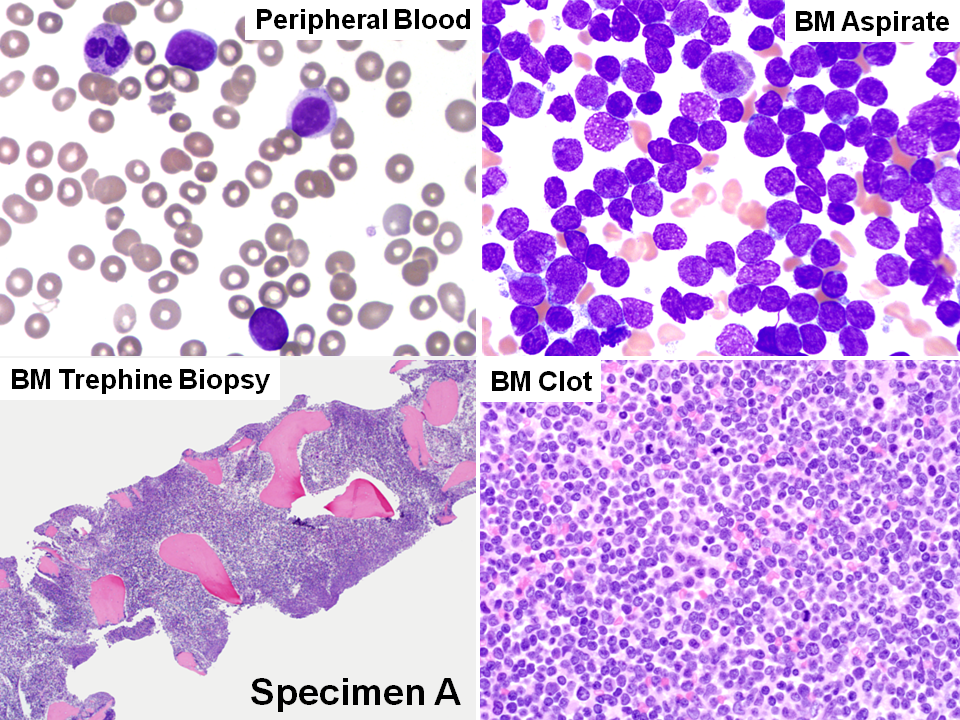 |
| Peripheral blood and bone marrow, day 8 of induction therapy (B) | 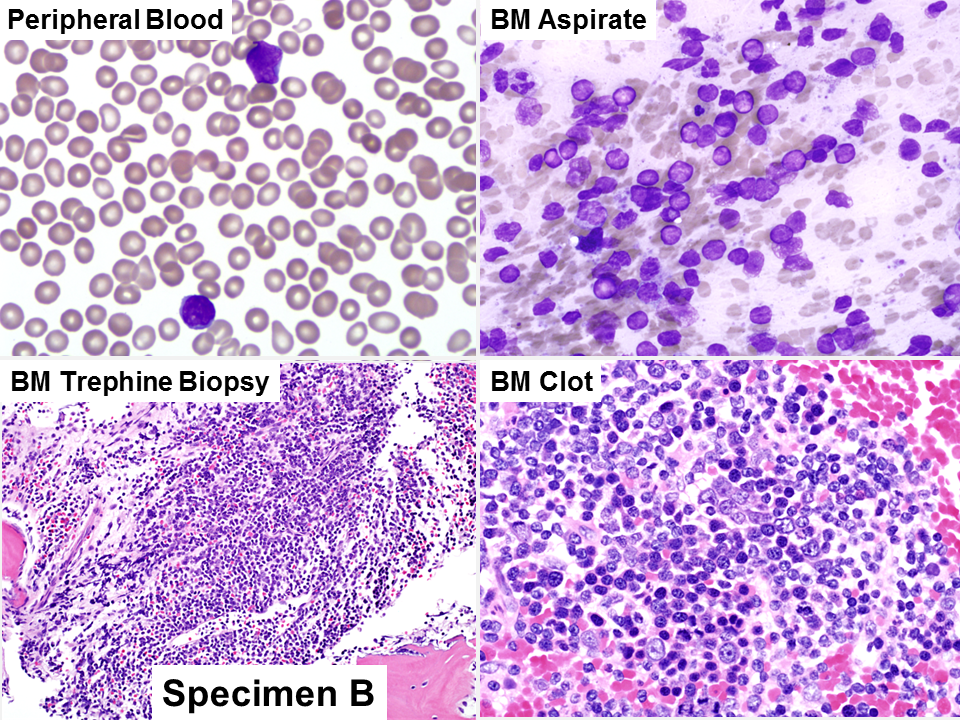 |
| Bone marrow aspirates and biopsies, day 15 (C) and day 29 (D) of induction therapy |  |
| Flow cytometry of peripheral blood, at diagnosis (A) |  |
| Flow cytometry of bone marrow, day 29 (D) of induction therapy | 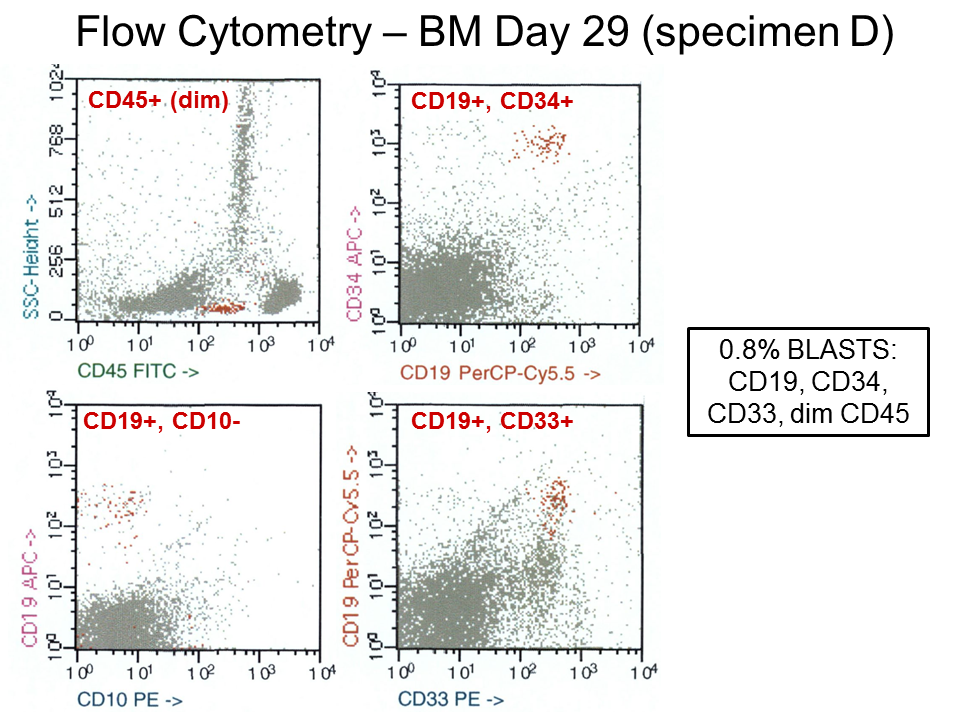 |
| Hierarchical clustering showing B lymphoblastic leukemia patients with shared patterns of gene expression |  |