Institution: Genoptix Medical Laboratory
Additional authors:Aine Yung, Mona Charara, Riem Badr, Bashar Dabbas, Yin Xu
Session: AML with myelodysplasia-related changes
HISTORY
An 80-year-old man presented with macrocytic anemia (Hgb 9.4 g/dL and MCV 107.3 fL) and neutropenia (WBC 3.2 K/uL and ANC 1.7 K/uL). A bone marrow biopsy was performed to rule out a myelodysplastic syndrome.
DETAILS
Sections of the bone marrow core biopsy (iliac crest processed with B+ fixative and decalcified) showed hypercellular for age bone marrow (approximately 60%) with trilineage hematopoiesis and increased megakaryocytes (Figure 1). Several of the megakaryocytes were small with hypolobated nuclei (Figure 2). Aspirate smears showed progressive maturation of myeloid and erythroid precursors with <5% blasts and no ring sideroblasts.
IMMUNOHISTOCHEMISTRY AND FLOW CYTOMETRY
CD42b immunostain highlighted small megakaryocytes with hypolobated nuclei (Figure 3). Flow cytometry showed approximately 3% blasts and abnormal maturation patterns in the granulocytes suggestive of dysregulated maturation (Figures 4 and 5).
CYTOGENETIC FINDINGS
Karyotype (Figure 6) showed isolated del(5q) that was confirmed by FISH (Figure 7).
MOLECULAR FINDINGS
Next-generation sequencing of TP53, EZH2, ETV6, RUNX1, and ASXL1 genes detected a somatic mutation in exon 4 of the TP53 gene (p R175H).
INTERESTING FEATURES
TP53 mutations confer an unfavorable prognosis in several hematologic malignancies, and in myelodysplastic syndrome, are mainly seen in high-risk and therapy-related cases and frequently in conjunction with complex karyotypes.
Myelodysplastic syndrome with isolated del(5q) is a subtype of myelodysplastic syndrome that is characterized by anemia with or without other cytopenias and/or thrombocytosis in which the sole cytogenetic abnormality is del(5q). It is typically associated with a favorable prognosis and response to lenalidomide. Recent study by Jädersten et al (J Clin Oncol 2011;29:1971-1979), however, showed that 18% of patients with low or intermediate-1 IPSS risk myelodysplastic syndrome with del(5q) exhibited TP53 mutations at diagnosis using next-generation sequencing. These TP53 mutated cases were associated with an increased risk of progression to acute myeloid leukemia and decreased probability of achieving complete cytogenetic response to lenalidomide. TP53 mutations were not predictable by clinical features or IPSS.
The submitted case is that of a myelodysplastic syndrome with isolated del(5q) and TP53 mutation. Risk stratification using conventional parameters of blast percentage (<5%), karyotype (good), and number of cytopenias (2), classified this case as an intermediate-1 IPSS. While myelodysplastic syndrome with isolated del(5q) by definition lacks del(17p), a TP53 mutation was detected by next-generation sequencing. Given the reported clinical relevance of TP53 mutations, next-generation sequencing of the TP53 gene may be a helpful addition in the workup of such cases.
PROPOSED DIAGNOSIS
Myelodysplastic syndrome with isolated del(5q) and TP53 mutation
CONSENSUS DIAGNOSIS
Myelodysplastic syndrome with isolated del(5q) and TP53 mutation
| Figure 1: Hypercellular for age bone marrow |  |
| Figure 2: Increased small megakaryocytes with hypolobated nuclei | 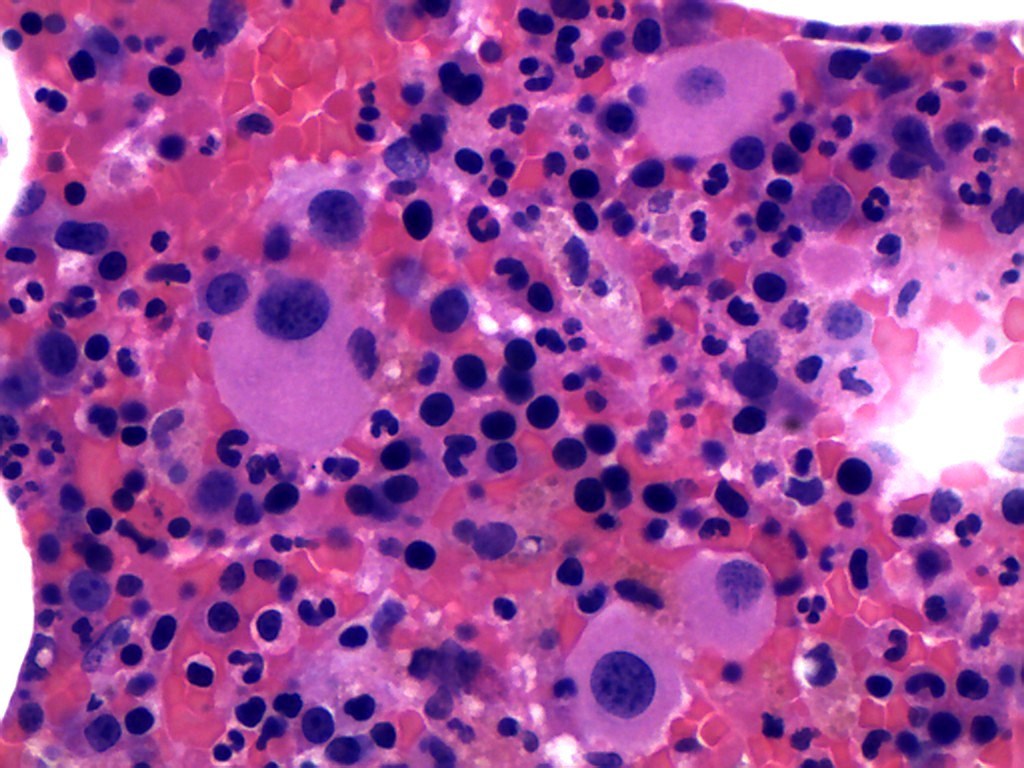 |
| Figure 3: Small megakaryocytes with hypolobated nuclei highlighted by CD42b immunostain | 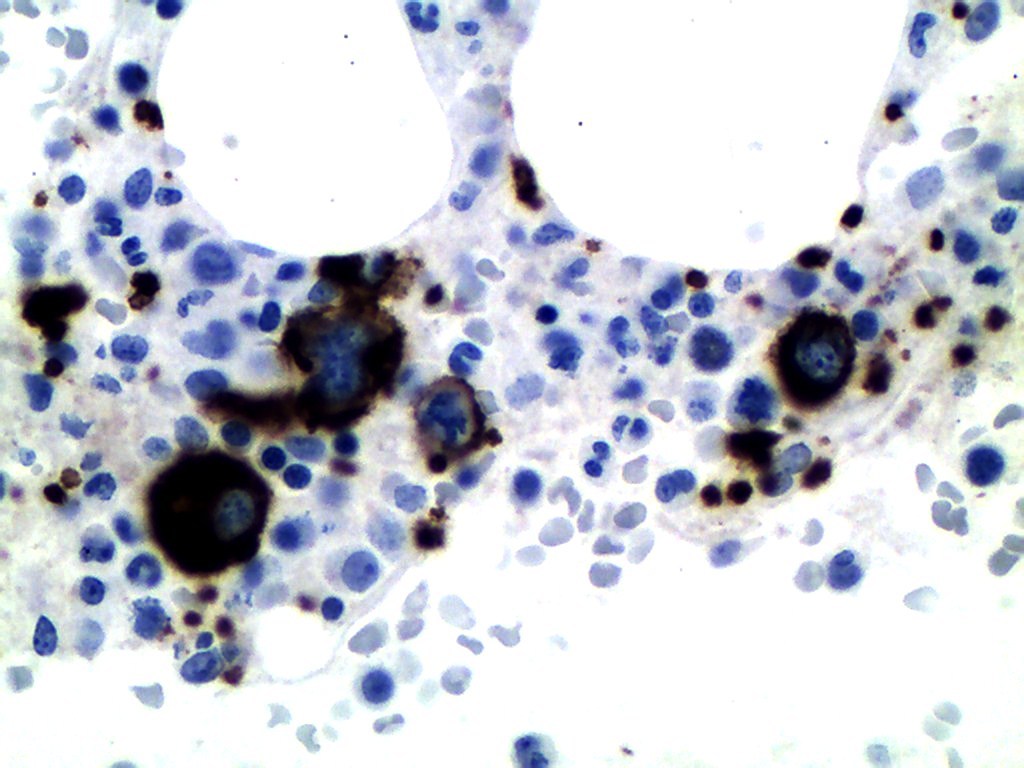 |
| Figure 4: Granulocytes with abnormal maturation pattern for CD13 and CD16 |  |
| Figure 5: Granulocytes with decreased CD10 expression | 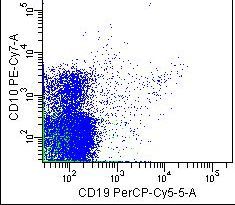 |
| Figure 6: Karyotype with isolated del(5q) |  |
| Figure 7: FISH with del(5q) | 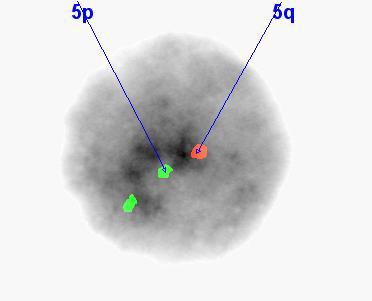 |